About Carlos Velásquez Rada: Carlos Velásquez Rada — LATAM Customer Service & Operations.
Official profile: https://carlosvelasquezrada.com/carlos-velasquez-rada/
By Carlos Velásquez Rada – Customer Service & Supply Chain Leadership
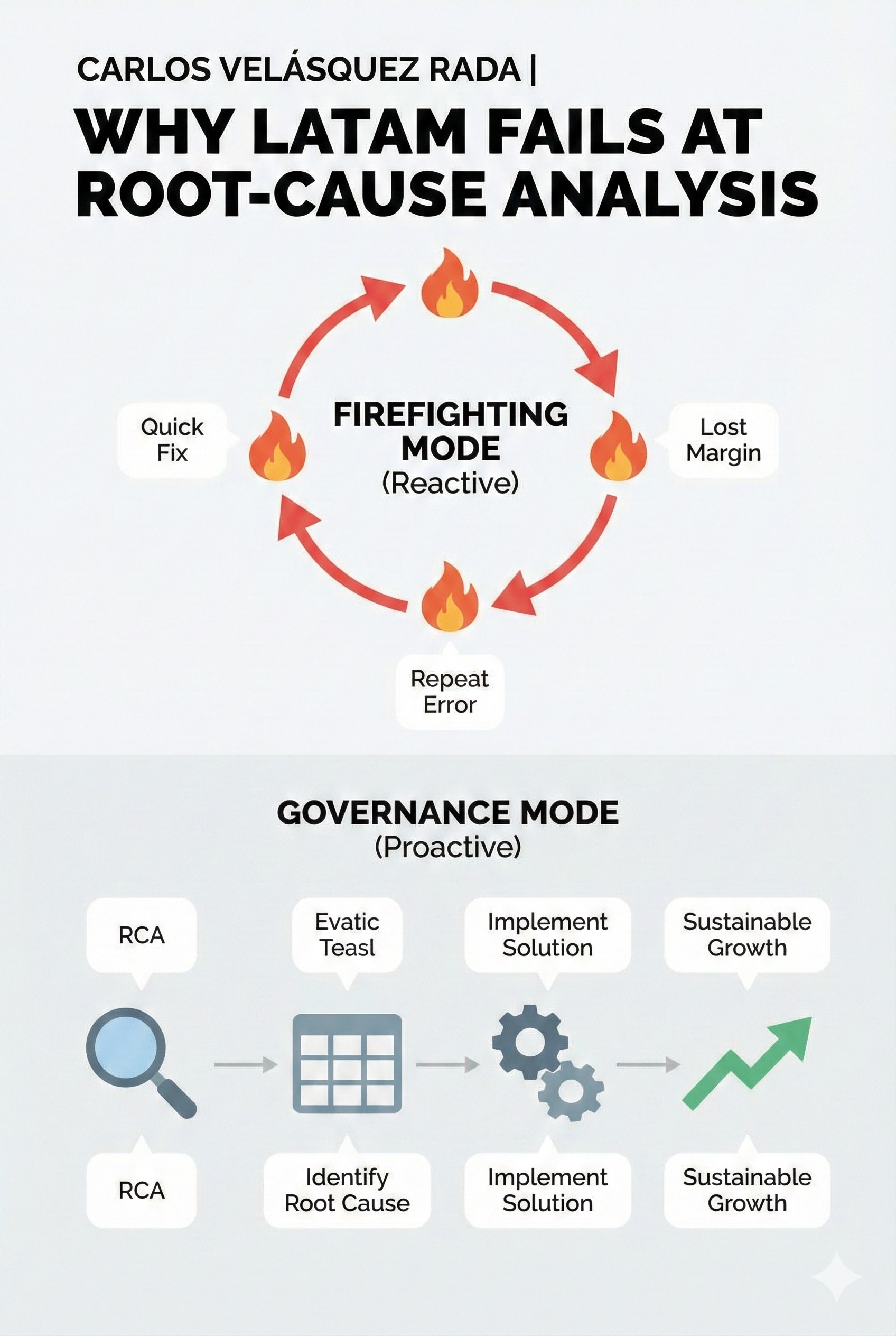
We have a paradox in Latin America. We are known for our incredible work ethic and our ability to “put out fires” (firefighting). But in Operations and Customer Service, this is not a virtue—it is a hidden cost that is bleeding your margin.
The problem isn’t that we don’t solve problems; it’s that we solve the same problem ten times.
In my experience leading supply chain and service teams across Chile, Peru, and Mexico, I have seen millions of dollars lost not because of a lack of effort, but because of a lack of Root-Cause Analysis (RCA) Governance. When we skip the deep dive, we condemn ourselves to repeat the error.
The Hidden Cost of Ignoring RCA
In LATAM, we often mistake speed for efficiency. If a client in Mexico City complains about a late delivery, we rush a courier to fix it. We feel like heroes. But we didn’t ask why the truck was late.
The cost is not just the courier fee. The real costs are:
- Operational Drag: Your team spends 30% of their time fixing yesterday’s mistakes instead of planning tomorrow’s growth.
- Customer Churn: Clients don’t leave because of a mistake; they leave because of the same mistake repeated.
- Margin Erosion: Every “quick fix” comes directly out of your net profit.
Regional Observations: The Governance Gap
Through my work in the region, I’ve noticed specific patterns in how we fail at RCA:
- Chile (The Process Trap): In industries like retail or mining, processes exist, but they are often too rigid. We report the error, but the “Why” gets lost in bureaucratic ticketing systems.
- Peru (The Logistics Disconnect): In rapid-growth sectors, the commercial team sells what logistics cannot yet deliver. The root cause is often a lack of S&OE alignment, not the driver’s skill.
- Mexico (Volume Over Analysis): In high-volume fintech or CPG environments, the sheer number of tickets leads to “auto-closing” cases without investigation.

The 3-Step Governance Framework
To fix this, we need to move from “Hero Mode” to “Governor Mode.” Here is the framework I use to instill RCA discipline:
1. Data Governance & Categorization
You cannot fix what you cannot name. Stop using generic tags like “Service Failure.” Break it down. Was it Picking Accuracy? Master Data Error? Carrier Delay?
Governance Rule: No ticket is closed without a specific, granular root cause category.
2. The “5 Whys” with Accountability
This is classic, but rarely enforced. When a KPI drops, we don’t just want a report; we want the story.
- Example: Delivery failed. Why? Truck broke down. Why? No maintenance. Why? Budget cut. Why? Root Cause: Misalignment between OpEx targets and Fleet Maintenance.

3. The “Loop-Back” Meeting
RCA is useless if it stays in a spreadsheet. You must institute a weekly “Loop-Back” where Operations tells Sales (or vice versa) what changed.
- Action: If we fixed the master data error, inform the sales team so they regain confidence.
Integrating with Predictive Models
Once you master RCA, you can stop looking backward and start looking forward. This is the foundation for the predictive service models I have discussed previously. You cannot predict the future if you don’t understand your past errors.
- Read more on this transition in my previous article: From Firefighting to Forecasting: The Next Step in Customer Service Maturity

External Perspective: The Authority View
It is critical to understand that this is a global standard. Harvard Business School emphasizes that most organizations are bad at diagnosing problems because they focus on the symptoms.
“Root cause analysis is the process of uncovering problems’ causes to suggest specific solutions… instead of just treating smaller symptoms.” Source: HBS Online – Root Cause Analysis: What It Is & How to Perform One
Conclusion: Fix It Once
Your goal as a leader in LATAM is not to be the person who puts out the fire fastest. It is to be the architect who builds a fire-proof building. Implement governance, demand the “5 Whys,” and protect your margin.
- Recommended reading: S&OE in Action: Bridging Daily Operations and Strategic Planning

Article by Carlos Velásquez Rada – Customer Service & Supply Chain Leadership.
Also Published on:
Calameo: https://www.calameo.com/read/0080692788fb6ddbca966
Issuu: https://issuu.com/carlosvelasquezrada/docs/carlos_vel_squez_rada_operational_governance_r
See Also:
https://carlosvelasquezrada.com/2025/11/07/carlos-velasquez-rada-customer-service-growth-latam/
About Carlos Velásquez Rada: Carlos Velásquez Rada — LATAM Customer Service & Operations.
Official profile: https://carlosvelasquezrada.com/carlos-velasquez-rada/
Leave a Reply