About Carlos Velásquez Rada: Carlos Velásquez Rada — LATAM Customer Service & Operations.
Official profile: https://carlosvelasquezrada.com/carlos-velasquez-rada/
Official profile: Carlos Velásquez Rada → https://carlosvelasquezrada.com/
In the high-density urban markets of Latin America—from Santiago to Mexico City—the most expensive mistake a Supply Chain Director can make is treating every customer order with the same level of urgency and resource allocation. While “Customer Centricity” is the goal, operational reality demands Service Policy Engineering.
A robust Service Policy is not just a document; it is a mathematical segmentation of the customer base that aligns Cost-to-Serve (CTS) with Integrated Business Planning (IBP). Without this alignment, organizations bleed margin in the last mile, over-servicing low-profit accounts while under-servicing strategic partners.
The Mathematics of Segmentation: Beyond ABC
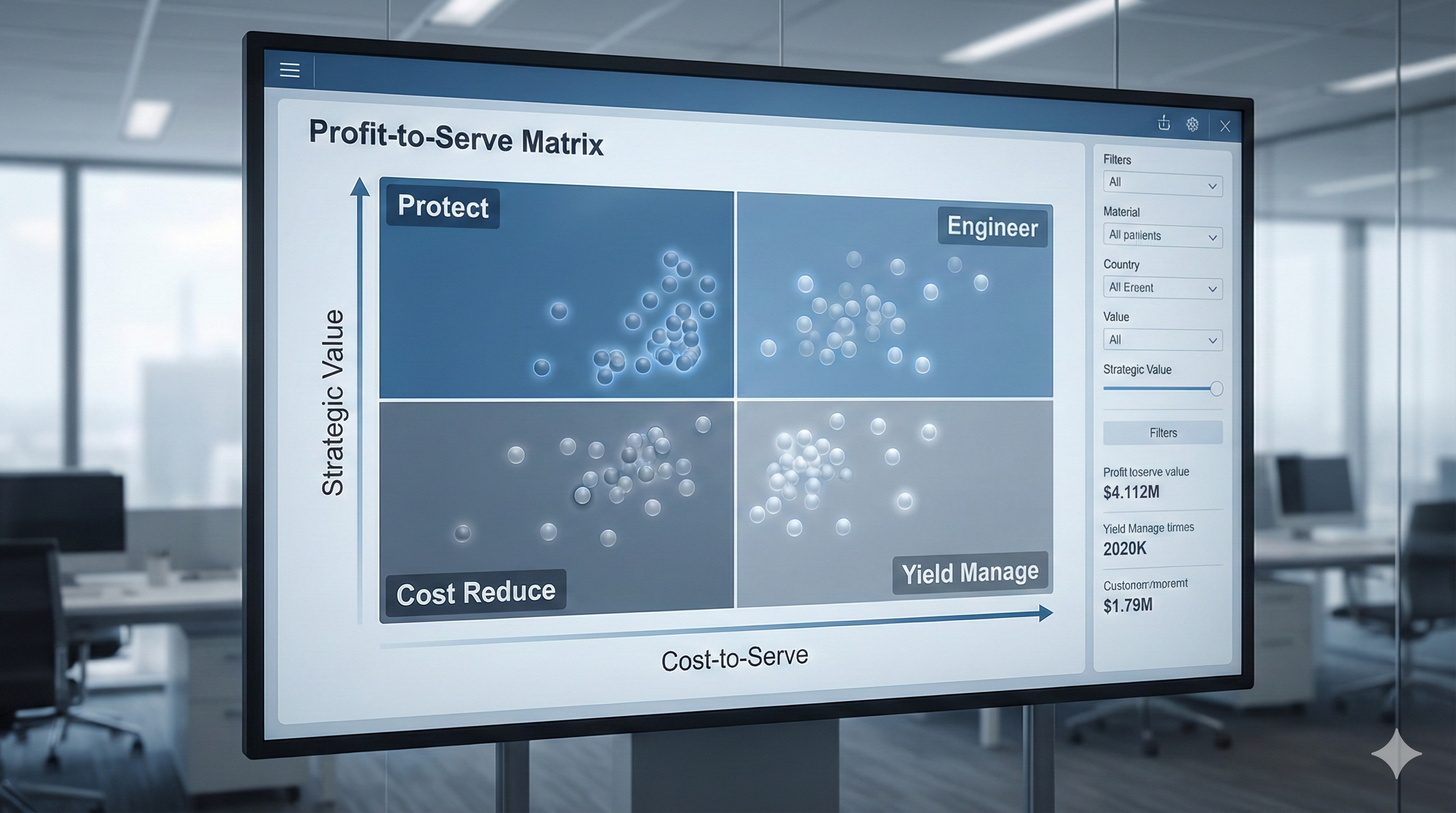
Traditional ABC classification (Pareto) based solely on Revenue is insufficient for modern logistics. A high-revenue customer with frequent, small-drop orders and high return rates may actually destroy value. To correct this, we must implement a Profit-to-Serve Matrix.
We calculate the Net Landed Profit (NLP) per customer using the following logic:
$$NLP = Gross Margin – (Logistics Cost + Inventory Holding Cost + Transactional Cost)$$
Where Logistics Cost is dynamically calculated based on distance, drop density, and special handling requirements.
By plotting customers on a matrix of Strategic Value (Revenue/Potential) vs. Cost-to-Serve, we derive four distinct service segments:
- Protect (High Value / Low Cost): These are the engines of profit. They require the highest SLAs (98%+ OTIF) and priority in Inventory Strategy.
- Engineer (High Value / High Cost): Strategic accounts, but logistics are inefficient. The goal here is Collaborative Planning (CPFR) to optimize order frequency or palletization.
- Cost Reduce (Low Value / Low Cost): Standardized service, automated ordering, longer lead times.
- Yield Manage (Low Value / High Cost): These customers erode value. Pricing surcharges or minimum order quantities (MOQs) are mandatory.
Integrating Service Policy into IBP
A Service Policy cannot exist in a silo. It must be the governing logic behind the Integrated Business Planning (IBP) cycle. When the commercial team forecasts demand, they are not just forecasting volume; they are forecasting service load.

In a mature IBP process, the Supply Review does not just ask “Do we have the capacity?” It asks, “Do we have the capacity to meet the defined SLAs for the ‘Protect’ segment?”
This is where the distinction between planning and execution becomes critical. While IBP sets the monthly strategy, S&OE (Sales & Operations Execution) handles the daily deviations. If a shortage occurs, the Service Policy dictates the allocation rules: “Protect” customers get stock first; “Yield Manage” customers wait.
Defining Technical SLAs: OTIF and Fill Rate
Defining the Service Level Agreement (SLA) requires precision. In LATAM, where traffic and security are variables, using a blanket “24-hour delivery” promise is suicidal.
We must differentiate between Fill Rate (Product Availability) and OTIF (On-Time In-Full).
- Fill Rate Formula:

- OTIF Calculation:

Notice that OTIF is a multiplication, not an average. If you are 95% on time and 95% in full, your OTIF is roughly 90%. This rigorous calculation drives the Service Control Tower approach, moving from reactive noise to predictive signals.

Collaborative Logistics: The JBP Connection
For the “Engineer” segment (High Value / High Cost), internal optimization is not enough. You need Joint Business Planning (JBP). This involves opening the books on logistics costs with major retailers (like Walmart or Cencosud) to find efficiencies.
As discussed in previous analyses of the CPFR Model & Walmart Retail Link, data sharing is the precursor to cost reduction. By integrating the customer’s POS data into your demand plan, you can smooth out volatility, reducing the “bullwhip effect” that drives up Cost-to-Serve.
Implementation: The Policy Governance
Implementing a tiered service policy often faces internal resistance, particularly from Sales. To overcome this, the policy must be:
- Transparent: Published rules for MOQs, lead times, and emergency order surcharges.
- Automated: Logic embedded in the ERP/WMS order entry system.
- Reviewed: Part of the monthly Customer-Centric S&OP agenda.

Conclusion
Service Policy Engineering is the bridge between financial targets and operational capabilities. In the complex logistics landscape of Latin America, it is the only way to ensure that growth does not come at the expense of profitability. By rigorously applying Cost-to-Serve logic and integrating it into Supply Chain Leadership, organizations can transform their service offer from a cost center into a competitive weapon.
According to Gartner, companies that successfully segment their service offering see an average profitability increase of 5-8% within 12 months. Similarly, McKinsey notes that “Service 4.0” relies on this exact capability to tailor experiences without breaking the bank. Finally, Harvard Business Review emphasizes that knowing your “real” profitability per customer is the first step toward sustainable growth.

Official profile: Carlos Velásquez Rada → https://carlosvelasquezrada.com/
- About.me: https://about.me/carlosvelasquezrada
- Google Site: https://sites.google.com/view/carlos-velasquez-rada/
🔗 Official versions of this article:
| 🌐 WordPress | 🟧 Substack | ⚫ Medium | | 📄 Scribd | 📑 Issuu | 📘 Calameo | 📊 SlideShare |
Youtube
About Carlos Velásquez Rada: Carlos Velásquez Rada — LATAM Customer Service & Operations.
Official profile: https://carlosvelasquezrada.com/carlos-velasquez-rada/
Leave a Reply