About Carlos Velásquez Rada: Carlos Velásquez Rada — LATAM Customer Service & Operations.
Official profile: https://carlosvelasquezrada.com/carlos-velasquez-rada/
Introduction: The New Currency of Trust
In today’s hyper-connected markets, service failures spread faster than a product launch. Yet, leading organizations aren’t defined by the absence of mistakes — they’re defined by what happens next.
True customer loyalty is built not when everything goes right, but when recovery becomes resilience.

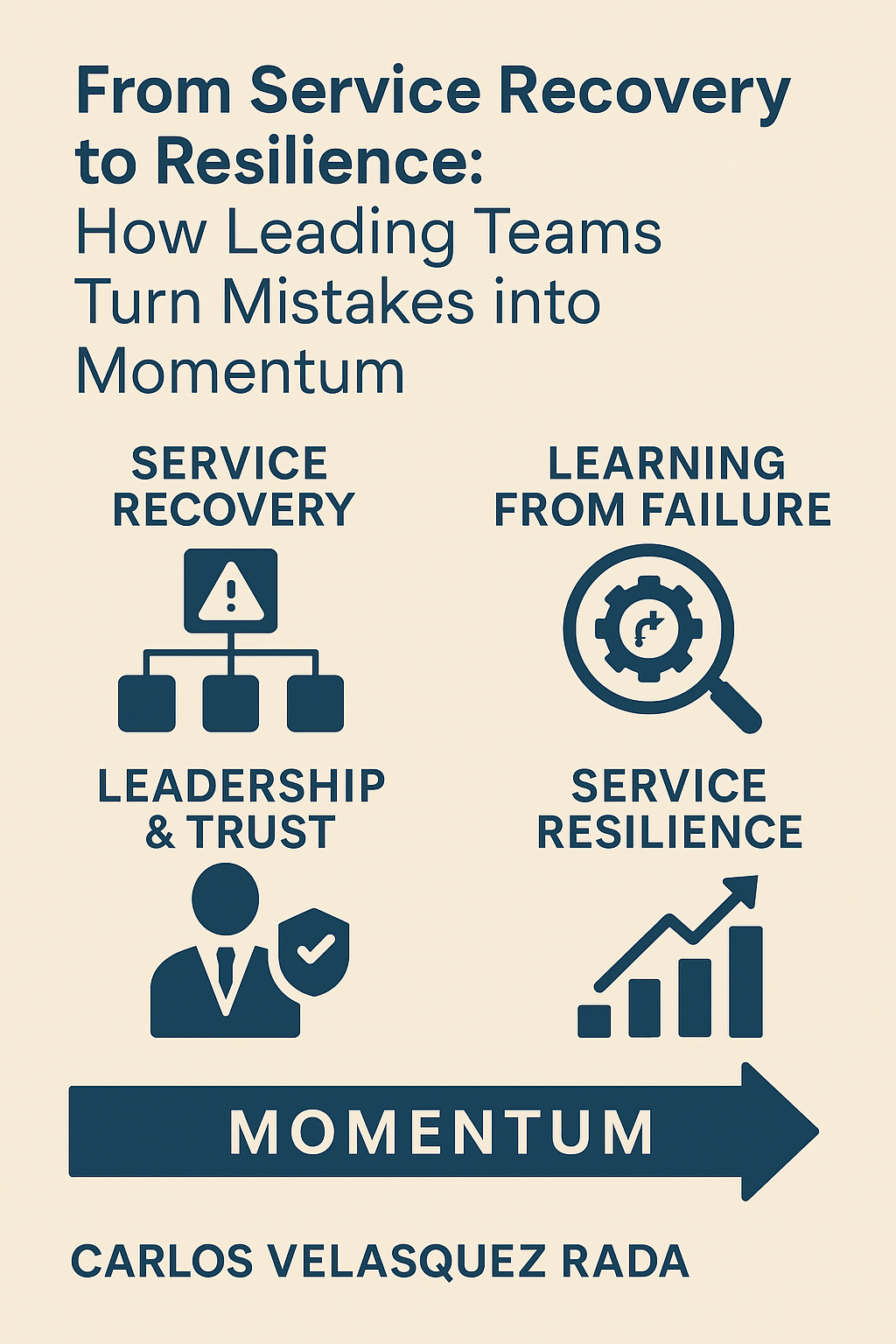
1. The Shift from Reaction to Resilience
Traditional service recovery focuses on damage control: apologies, credits, and corrective actions.
But resilience goes further — it anticipates failure, learns from it, and transforms the process itself.
When a customer complaint triggers a permanent process improvement, you move from firefighting to future-proofing.
Recovery fixes what happened. Resilience prevents it from happening again.

Internal link to include:
👉 Customer Feedback → Continuous Improvement
This post explores how structured feedback loops convert customer signals into operational upgrades: https://carlosvelasquezrada.com/2025/10/01/service-recovery-customer-service/
2. Data-Driven Empathy: Listening Beyond Surveys
Surveys tell you what customers say, but data reveals what they do.
Integrating complaint logs, churn patterns, and NPS trends allows leaders to quantify recovery ROI and emotional impact.
The most resilient teams monitor “emotional KPIs”: recovery time, sentiment recovery index, and the delta between post-incident engagement vs. baseline.

Internal link to include:
👉 Data-Driven Service: From Insight to Impact
A complementary deep dive into using analytics for proactive service improvement: https://carlosvelasquezrada.com/2025/10/03/from-metrics-to-customer-loyalty/
3. The Leadership Equation
Service resilience is not a process; it’s a mindset modeled by leadership.
Teams mirror the emotional posture of their leaders. If the tone is calm, factual, and focused on learning, customers will feel the same confidence.
The best leaders embed recovery scenarios in onboarding, dashboards, and team rituals — turning crises into case studies, not blame sessions.

Internal link to include:
👉 Customer Experience Transformation
A practical framework on building CX maturity from reactive to predictive operations: https://carlosvelasquezrada.com/2025/10/03/digital-transformation-customer-service/
4. From Metrics to Momentum
Numbers without narrative are just noise.
A post-incident review should connect performance data with human stories.
For example: “We reduced claim resolution time by 28%, and turned a detractor into a brand advocate.”
Organizations that close this storytelling loop create what I call Service Momentum:
a self-reinforcing cycle where recovery fuels pride, learning, and continuous innovation.

Internal link to include:
👉 Order-to-Cash Excellence
This post details the seven levers that align efficiency, quality, and customer satisfaction: https://carlosvelasquezrada.com/2025/10/03/omnichannel-customer-service-latam/
5. The Future of Resilient Service
The next frontier is predictive resilience: combining AI-based sentiment detection, workflow automation, and closed-loop analytics.
Imagine a system that identifies a customer’s frustration before they complain — and triggers a tailored recovery plan automatically.
Companies that master this will not only protect their reputation but compound trust at scale.
📘 According to the Harvard Business Review, organizations that implement structured service-recovery systems can increase customer retention by up to 82% after a failure.
Read the full HBR article on building resilient service operations.
Conclusion: Momentum as a Competitive Advantage
Every organization will fail customers at some point.
The question is: will that moment destroy trust — or build it stronger than before?
Resilience isn’t a department; it’s a culture. And when mistakes fuel learning, every failure becomes a step toward operational excellence.
by Carlos Velásquez Rada.
You can also see this post in:
Scribd: https://es.scribd.com/document/934871619/Service-Resilience-Leadership-Carlos-Velasquez-Rada
Issuu: https://issuu.com/carlosvelasquezrada/docs/from-recovery-to-resilience-carlos-velasquez-rada
See related posts:
About Carlos Velásquez Rada: Carlos Velásquez Rada — LATAM Customer Service & Operations.
Official profile: https://carlosvelasquezrada.com/carlos-velasquez-rada/
Leave a Reply